

AI will transform pharma, but not evenly and not all at once. Some parts of drug discovery and development are already software-like: faster, cheaper, iterative, driven by model improvements. Others stay bound by the physical world, such as recruiting patients, dosing them, and waiting years for an endpoint to read out. The sequence in which these frontiers move determines where value concentrates and where it erodes.
Building an enduring company in the age of AI is hard precisely because advantages can dissipate rapidly as models improve. Each major release can redraw the line between what was previously a standalone product (or even company) and what a frontier lab now offers natively. Companies that looked durable in one generation get exposed in the next, not because they executed poorly, but because the capability layer moved forward and absorbed what used to be their edge. We have watched this play out in other categories and our industry is not immune.
The companies that win will predict the uneven frontiers correctly, absorbing each model improvement as a tailwind rather than a headwind. Our view: discovered drugs are becoming abundant while clinical development remains the binding constraint — so the durable position is built around that bottleneck, not in the path of advancing discovery models. Here is how we see it playing out, and why.
Discovered drug candidates become abundant
The first major shift is that drug discovery is becoming dramatically more efficient.
This trend began well before AI. Over the past decade, the industry has become much better at generating plausible therapeutic assets. The number of discovered drug candidates has roughly doubled, while the number of approved drugs has remained constant at around 50 per year.

Figure 1. The pipeline doubled. Approvals didn’t. FDA CDER approved 50 novel drugs in 2024, consistent with the general recent pattern of annual novel drug approvals clustering around several dozen per year rather than scaling with the total R&D pipeline. Sources: Citeline, Annual Pharma R&D Review (pipeline); FDA, Summary of Approvals (approvals).
That gap reveals a critical truth: discovery has not been the primary bottleneck — development and clinical trials have. In addition to unrealized commercial value, the cost of this gap is that treatments never reach the patients who need them. In an era of drug abundance, discovery will likely become less of a constraint than development. To fully harness the promise of AI for patients, we must solve the drug development bottleneck.
Markets already price this distinction. A discovered drug is worth relatively little before meaningful clinical validation, and dramatically more after convincing human proof of concept. Preclinical discovery deals often carry upfronts in the tens of millions per asset. By contrast, after strong Phase 2 data, pharma may pay hundreds of millions to billions of dollars for the same underlying asset class.
That spread is the market’s way of saying that molecule discovery is only one layer of value creation. The larger inflection comes when biology, patient selection, dosing, endpoints, and clinical strategy are validated by human data.
AI will accelerate this shift. Improvements in screening, structural biology, computational chemistry, biological datasets, platform biotech, and now AI are increasing the number of plausible therapeutic assets that can be generated. AI-enabled drug design is moving from a scarce technical frontier toward a broadly accessible platform capability. The rise of China as a drug discovery and development engine adds another accelerant.
This is a major scientific achievement. But it also changes the economics of the industry. If the number of discovered drugs increases substantially, then discovery itself becomes less scarce. There will be more drugs per target, more companies pursuing similar biology, more assets available for licensing, and more molecules that look plausible at the preclinical or early clinical stage.
The world will have far more discovered drugs than it can actually develop.
That likely means “we discovered a drug” becomes a weaker basis for durable company value. A discovered asset can still create value, but the market will ask harder questions: Is this the right drug? Is this the right target? Is this the right patient population? Is there a credible clinical path? Is the biology differentiated? Can this become a product?
In a world of drug discovery abundance, the scarce capability is no longer making drugs, but rather, knowing which drugs are worth developing.
More drugs per target likely means lower value per discovered asset.
As discovery becomes more efficient, more companies will converge on the same attractive targets.
When a target is compelling, better tools will make it easier for the field to generate multiple molecules, modalities, and development hypotheses against it. The result will not be one perfect drug per target, it will be many plausible drugs per target.
This creates a paradox: AI may make it easier to create drugs, but that does not necessarily make each drug more valuable.
In fact, the opposite may happen. As the cost of generating a plausible asset falls, the supply of early assets will rise. More companies will be able to create something that looks credible enough to fund, partner, or advance. But abundance changes the economics. The marginal discovered drug becomes cheaper to produce, easier to replicate, and therefore less scarce.
We are already seeing this happen. Over the past two decades, the number of drugs being developed against each target has increased meaningfully — from roughly two to three drugs per target to seven or eight, and in some cases fifteen or more. If discovery tools continue to improve, it is reasonable to expect that number to rise further, potentially to twenty, thirty, or even fifty programs against the most attractive targets. For example, in 2025, there were more than 100 programs targeting PD-1 and GLP-1s each.

Figure 2. Drugs per attractive target keep climbing — and outliers are already in the hundreds (McKinsey Life Sciences, 2025). Range covers typical attractive targets. Mega-targets like PD-1/PD-L1 (200+ programs, DelveInsight 2025) and obesity/GLP-1 (193 assets, IQVIA Oct 2025) already far exceed these levels in 2025. The 2030 projection assumes ~2x current levels for typical targets, sourced from Quantum Black by McKinsey and others.
This has major implications for value creation.
Preclinical assets and discovery-stage companies will face increasing valuation pressure as the market recognizes that early assets are becoming more abundant. A molecule alone will no longer command the same premium if others can generate comparable molecules against the same target. Differentiation will shift toward what is harder and slower to prove: stronger translational evidence, prospective clinical data, the right endpoints, better patient selection, and a faster, more credible path to approval.
This does not mean discovery is unimportant. It means discovery alone is less likely to be the durable value inflection point. And we have already seen this empirically in the markets for the past 10 years — valuations for discovered drug candidates have decreased over time (pre-Phase 2 drugs).
Predictive models will improve unevenly
AI will improve prediction across pharma, but not all predictions are equally hard. The sequence of progress will be uneven, and that sequencing is important.
Prediction will improve first in the domains where data is abundant, variability is lower, benchmarks are clearer, and feedback loops are short. It will improve later in domains where biology is more heterogeneous, outcomes are harder to define, and validation requires long, expensive, prospective studies.
Put simply: drug discovery and design will improve first, toxicity prediction will improve next, and clinical efficacy will be last.

Figure 3. Three frontiers, three timelines. The diagonal traces the order in which AI prediction is likely to mature. Position reflects feedback loop length on the horizontal axis and benchmark clarity on the vertical axis.
Drug Design and Discovery — the most tractable frontier
We can define drug design as the process of identifying molecules that can meaningfully modulate a target of interest, whether by agonizing it, antagonizing it, inhibiting it, degrading it, or otherwise altering its function.
Among the major frontiers in drug development, discovery is likely the most tractable for AI because its feedback loops are comparatively short. Experiments can often be run in minutes, hours, or days. Benchmarks are very clear — we know what assays are needed to understand what binds to what, binding efficiency, potency, PK/PD properties. Assays are more scalable. The search space can be explored computationally. Models can generate hypotheses, test them against available data, and improve through repeated iteration.
This does not make discovery easy, but it makes it more software-like than other parts of drug development. Understanding whether a drug can be designed to bind, agonize, or antagonize a given target is becoming increasingly efficient. Billions of dollars are flowing into companies focused on solving this problem. But all this together means that drug discovery will likely be commoditized first, and value will not accrue at this part of the chain unless you translate these discoveries into post-clinical readout validation.
Toxicity — harder, but next
Toxicity prediction is harder than discovery, but it is likely the next frontier to improve meaningfully with AI. We can define toxicity prediction as the ability to anticipate whether a molecule will produce harmful effects in humans using evidence from in silico models, cellular systems, organoids, and lower-order animal models.
The biology is more complex, but the problem is still comparatively structured. We often know what a toxicity signal looks like. There are recurring failure modes, established assays, historical datasets, and staged experimental systems that progress from cells to organoids to genetically similar animal models and, eventually, to humans.
The feedback loops are longer than in discovery, but still much shorter than clinical efficacy. Experiments may take weeks rather than years, and many toxicity questions benefit from repeated patterns across molecules, tissues, species, doses, and mechanisms.
That makes toxicity a natural next domain for AI-driven improvement. It is not as software-like as discovery, but it has enough structure, repetition, and measurable signal for models to become increasingly useful over time.
Clinical efficacy — the hardest frontier
Let’s define clinical efficacy prediction as the ability to predict whether a candidate drug will work in patients without needing to run a trial. This is the holy grail, and we expect it will be the last frontier to be solved.
Clinical efficacy depends on the full complexity of human biology: disease heterogeneity, patient selection, dose, duration, endpoints, standard of care, adherence, trial design, site execution, and statistical power. A model may predict that a molecule engages a target. It may predict that the molecule is likely to be safe. But predicting whether that drug will produce a clinically meaningful benefit in the right patients, under real-world trial conditions, remains far more difficult.
One reason is that the datasets required to solve this problem largely do not exist yet. To predict efficacy reliably, we would likely need something like a UK Biobank on steroids: multimodal, longitudinal, deeply phenotyped, multi-omics datasets across millions of patients, linked to treatments, outcomes, disease progression, biomarkers, imaging, clinical notes, adherence, environment, and real-world follow-up. And we would need those datasets not just observationally, but across enough perturbations — enough drugs, doses, mechanisms, patient subtypes, and controlled interventions for models to learn which biological changes actually translate into clinical benefit.
Today, that data is sparse, fragmented, biased, and unevenly distributed across institutions, trials, EHRs, registries, biobanks, omics platforms, and pharma archives. Unlike internet-scale AI, where models can learn from enormous volumes of naturally occurring text, clinical efficacy prediction requires data from expensive, slow, ethically constrained human experiments. The most important labels — whether a drug works, in whom, at what dose, against which endpoint, and under which conditions, are generated through trials that take years.
Unlike toxicity, where many failure modes are observable, repeatable, and measurable in staged systems, efficacy often lacks clean benchmarks. We do not always know what “getting better” looks like in a way that is stable, quantifiable, and easy for models to learn, especially in complex diseases like Alzheimer’s, autoimmune disorders, metabolic disease, and many areas of neurology.
Even in diseases we understand better, efficacy remains difficult to predict because human response is heterogeneous. Patients vary in baseline biology, disease progression, comorbidities, prior treatment history, adherence, environment, and response to intervention. We are often still uncertain about natural variability, responder and non-responder populations, and how small-scale biological perturbations translate into meaningful outcomes at human scale.
The consequence of uneven frontiers and rates of change
This creates an important sequencing implication:
1. First, the industry will have more promising discovered molecules than it can develop.
2. Then, it will have more molecules that appear likely to be safe.
3. The last major unknown will be whether those molecules are actually efficacious in patients — and that uncertainty will remain hard to resolve until the industry has much richer human datasets and many more prospective clinical feedback loops.
In other words, clinical efficacy prediction is not just a harder modeling problem. It is a missing-data problem, a human-biology problem, and a feedback-loop problem. That is why clinical development remains the central bottleneck.
What if we are wrong, and clinical efficacy prediction happens far faster than expected?
Even if we eventually have a black-box model that could predict clinical efficacy with high accuracy, it is unlikely that regulators would immediately allow drugs to be approved without prospective clinical trials. They would need to see repeated evidence that the model works in practice. How many prospective trials would need to read out correctly before regulators became comfortable relying on such predictions? Five? Ten? Twenty? And even then, validation in one disease area would not automatically transfer to another. A model that performs well in oncology would still need to prove itself in neurology, immunology, cardiometabolic disease, and other therapeutic areas.
Because each prospective validation cycle can take years, regulatory adoption will lag model capability. AI may improve our confidence, sharpen our development decisions, and increase the probability of success, but it will not eliminate the need for clinical proof anytime soon.
As long as regulators require prospective human clinical trials, clinical development will remain the bottleneck. Unlike discovery or toxicity prediction, it is constrained by the physical realities of drug development: manufacturing clinical supply, completing CMC work, recruiting patients, treating them for the required duration, and waiting for endpoints to be met. These steps can be made faster and more efficient, but they cannot be compressed from years into days or weeks. The limiting factor is not just computation; it is the irreducible time required to test medicines in humans. We suspect that one day, trials can be done in silico, but the data required to train such predictive AI models don’t yet exist (e.g. UK BioBank on steroids: millions of patients, genomic, proteomic, transcriptomic, imaging, longitudinal study, multiple perturbations).
This is why clinical development remains the central bottleneck in pharma. Markets already reflect this reality. Assets are worth far more after Phase 2 readouts because that is where the most important uncertainty begins to collapse: not whether a drug can be discovered, and not only whether it can be safe, but whether it can actually help patients and modulate a clinical endpoint that matters.
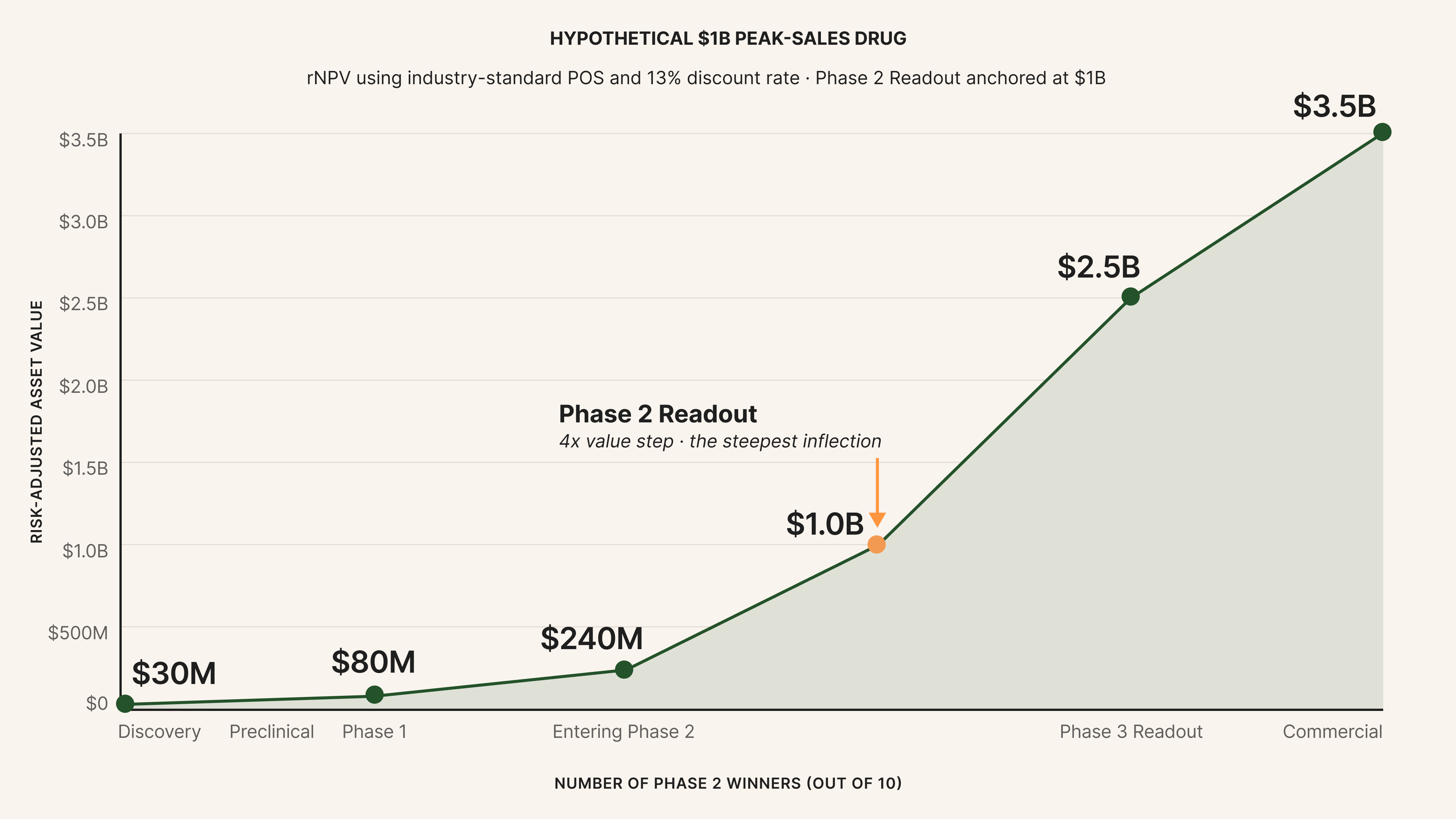
Figure 4. A hypothetical $1B peak-sales drug — where value gets created. Risk-adjusted asset value at each development stage. Phase 2 readout anchored at $1B; values use industry-standard probability of success and a 13% discount rate (biotech-typical). The single steepest inflection — a 4x step — occurs from Phase 1 readout to Phase 2 readout.
That final unknown of clinical efficacy is where the most durable value will continue to accrue.
The Key Epistemological Question: How and when do you know you are better than industry averages?
There is also a fundamental epistemological question that almost every biotech company must grapple with. Even if you have a model or platform that you believe predicts clinical stage efficacy at a higher rate, when and how do you know you are better than the industry average?
Clinical proof takes time, and small numbers are hard to interpret. If the baseline Phase 2 probability of success is roughly 30%, and you run five Phase 2 trials and succeed in three (i.e., 60%), are you meaningfully better, or just lucky? If you run ten Phase 2 trials and succeed in five, that is encouraging, but still not statistically significantly better performance. Because Phase 2 trials can take two to four years to read out, it may require a decade or more, and many prospective readouts across therapeutic areas, before the market, regulators, or even the company itself can confidently distinguish true model-driven advantage from variance.
Even if models perform well on historical data, markets are unlikely to give full credit before prospective clinical proof. This is especially true for first-in-class drugs, where there is no clean precedent and where the core question is not merely whether a model can interpolate from the past, but whether it can predict a new biological and clinical reality. For best-in-class drugs (i.e., optimized molecule on known biology), investors may discount positive readouts as efficacy is generally already known.
That could create a type of valuation overhang. Investors may believe AI can improve probability of success, but they are unlikely to underwrite that improvement fully until they see repeated prospective evidence. This is especially true because the first generation of AI biotech companies has not yet clearly demonstrated a step-change improvement in clinical probability of success.
Put simply, the advantage still has to be proven in the clinic. Credibly claiming a statistically significant edge likely requires 10–20 prospective clinical shots that materially outperform industry benchmarks (need to hit at least 6 out of 10 or 10 out of 20 to hit statistical significance at p = 0.048). But if a company starts in discovery, it may run out of time or capital before it can generate that many Phase 2 readouts.
Proof, for now, still comes from the clinic.
Two ways to win, only one of which is more measurable now
But there is one advantage we can know much earlier: whether you can do drug development and clinical trials faster and more efficiently.
That is why the winning strategy is not to rely solely on better success prediction. It is to combine better prediction with a structurally superior drug development engine. If our models help us choose better assets, that is powerful — but you won’t know if you are actually better at prediction until after the drugs are read out clinically. If we can also develop those assets faster, cheaper, and with greater operational consistency, then we create an advantage that is measurable. Functionally, being able to take more shots for the same cost and time as a traditional company meaningfully increases your probability of success of hitting a winner.
This is the strategic wedge.
The company that wins will be the one that can both make better bets and resolve those bets faster and more efficiently.
Inverse Pascal’s Wager: Underwrite to industry averages and ensure you can take enough shots
Pascal’s Wager is an argument about decision-making under uncertainty. Pascal argued that, even if we cannot know whether God exists, belief is rational because the payoff structure is asymmetric: if you believe and God exists, the upside is infinite; if you believe and God does not exist, the downside is limited. The expected value is dominated by the possibility of infinite upside. And, of course, if you do not believe and an angry God does exist, the downside is infinitely bad.
For prediction of clinical probability of success, we subscribe to an inverse Pascal’s Wager.

Figure 5. A depiction of an inverse Pascal’s Wager.
It is tempting to believe that better models should translate into materially higher clinical probabilities of success. And over time, they may. But if we underwrite too aggressively to that belief and we are wrong, the downside is existential. We overpay for assets, take too few shots, overbuild around false confidence, misallocate capital, and risk killing the company.
The safer strategic posture is to assume industry-average probabilities of success until proven otherwise, and build a business model that works under that assumption.
Build a company that can take the appropriate number of well-underwritten shots even at industry-average odds.
The goal is to build a company that can take enough well-underwritten shots that it does not depend on needing to have a higher PoS (but of course do everything you can to achieve a higher PoS).
If the baseline Phase 2 probability of success is roughly 30%, then any single program is more likely to fail than succeed. But a portfolio changes the risk profile. A portfolio of 10 independent Phase 2 programs has only about a 2.8% chance of producing zero winners. Said differently, even at industry-average odds, taking enough disciplined shots dramatically reduces the risk of complete failure.

Figure 6. A portfolio of 10 has only a 2.8% chance of zero winners. Binomial distribution with n = 10 trials and p = 0.30 (industry-average Phase 2 probability of success). Sources: BIO and Wong, Siah & Lo. Even at average odds, a well-constructed portfolio of 10 produces a positive expected outcome with extremely low probability of total failure.
That is the asymmetry we want.
If we underwrite to industry averages and our models are actually better, we outperform. If we underwrite as though our models are better and they are actually average, we can misprice risk, overpay for assets, take too few shots, and destroy the company.
So the principle is simple: underwrite the company to industry-average probabilities of success, and let any predictive advantage show up as realized upside.
There is an important nuance. We should absolutely use predictive models to do everything you can to maximize PoS and rank assets, prioritize programs, estimate rNPV, and decide which shots are worth taking. The AI models should shape portfolio selection. But the company strategy should not depend on assuming that our predicted probability of success is already superior to the industry’s as that exposes you to existential risk.
If we have better predictive models, can run trials cheaper and faster, and can commercialize more efficiently, then we win twice: first through disciplined portfolio construction, and second through realized performance that exceeds the baseline.
Until those questions are answered, the right strategy is humility at the asset level and discipline at the portfolio level: assume average odds, take enough well-priced shots, and let better prediction create upside rather than fragility.
Our strategy and capabilities are built around the bottlenecks that emerge as AI creates uneven frontiers
For Formation Bio, the opportunity is to build around the bottleneck we believe will persist as AI reshapes pharma: clinical development. We license the most promising drugs and move them through clinical trials faster, cheaper, and more efficiently. In the near term, we sell or partner validated assets back to pharma after major value inflection, such as a Phase 2 readout. Over time, we will build toward commercializing our own medicines.
If we cannot find the assets we want, we may eventually pursue drug discovery ourselves, especially as discovery timelines collapse further. But in a world with more good drugs than available development capacity, even spending one to two years generating another candidate carries real opportunity cost. That time is better spent on the scarce capability and one most proximal to creating durable market value: identifying the best assets already available, matching them to the right indications, and moving them through clinical proof with greater speed and discipline. That is the strategic premise behind Formation.
Our platform is not a generic AI strategy. It is built around our specific view of the uneven frontier: discovery gets easier first, toxicity prediction improves next, and clinical efficacy and development remain the hardest and most valuable bottlenecks. We are building systems around the parts of pharma where scarcity and value will concentrate as AI changes the industry and the sequencing of what we work on is important.
If the uneven frontier plays out, AI will first enable the discovery of far more drug candidates, then more candidates with lower predicted toxicity risk, and eventually a growing abundance of plausible drugs whose biggest unresolved question is whether they work in humans.
That creates a very different world: not one where the scarce resource is a molecule, but one where the scarce resource is knowing which molecule, in which indication, for which patient population, with which trial design, is actually worth advancing. Many assets may look promising on paper, bind the intended target, and appear developable preclinically, yet still have large unanswered questions about clinical efficacy. At the same time, many target-indication pairings will remain unexplored, under-tested, or poorly understood.
If that is the case, three capabilities become most important.
First, we need to be the best at picking drugs
In a world with more assets than the industry can develop, asset selection becomes one of the most important capabilities in pharma. The company that wins won’t be the one that sees the most drugs, it will be the one to identify, earlier and more accurately than others, which assets are most likely to become valuable medicines.
This has always been the case, but now the universe of discovered candidates will dramatically increase as AI and China transform our industry.
Our platform comprises several key capabilities across the drug development lifecycle. Our AI system Atlas allows us to map and screen the universe of drug assets, competitive landscapes, and target-indication opportunities more efficiently and with greater scale than manual teams and processes. But seeing more opportunities is only useful if we can judge them better. The real advantage comes from combining AI-scale search with exceptional human judgment.
The best teams will still be differentiated by taste, judgment, and pattern recognition: the ability to know which risks are fatal, which are manageable, and which signals actually matter. The goal is not to make isolated one-off decisions, but to embed expert judgment (e.g. former Heads of R&Ds, biotech investors, PhDs) into the AI systems that evaluate assets, so Formation’s asset-selection capability compounds over time.
Our Delphi system closes that loop. It tracks clinical readouts across the industry, allowing us to learn not only from the drugs we own, but from every relevant trial the market runs. By comparing outcomes against our prior predictions, Delphi continuously sharpens our understanding of probability of success. Every readout becomes a learning event: which risks mattered, which signals translated, which assumptions were wrong, and which patterns should inform the next asset we evaluate.
Together, Atlas and Delphi form the foundation of a compounding drug-picking engine. Atlas expands the universe of assets we can see. Expert judgment teaches the system what to value. Delphi turns clinical outcomes into feedback that improves future decisions. Over time, asset selection becomes an institutional capability that strengthens with every asset we evaluate and every trial the industry reads out.
Second, we need to be the best at precision drug development and matching the right drug to the right patients
As more drugs emerge for each target, value will increasingly depend on matching each asset to the right indication, patient population, endpoint, and development path. The same molecule can be mediocre in one setting and highly valuable in another. The difference is often not the molecule alone, but the development strategy around it.
This is too large a search problem for a purely human process to do comprehensively and exhaustively. For every asset, there are many possible indications, patient segments, biomarkers, endpoints, comparators, trial designs, and commercial paths. Evaluating those options requires integrating genetics, real-world evidence, literature, omics, competitive intelligence, regulatory precedent, and market structure.
AI can compress that process. It can help us evaluate far more drug-indication pairs, compare more development strategies, and identify the settings where an asset has the strongest chance of becoming a valuable medicine.
That is the role of our Forge and Cassini systems. Forge helps evaluate development paths, simulate program options, and benchmark against prior studies. Cassini helps determine whether a program can meet a target product profile that creates meaningful market value. Together, they allow us to move from “Is this a good drug?” to the more important question: “Where, how, and for whom can this drug become a valuable medicine?”
Third, we need a development and capital advantage (more shots on goal)
If clinical trials remain the bottleneck in drug development, then the company that can run more high-quality trials, at lower cost and greater speed, will have a meaningful advantage. This is where Formation has a structurally different model. If we can take more shots per dollar, and finance those shots at a lower effective cost of capital, we can increase the probability of producing winners without proportionally increasing risk to the parent company.
Drug development is a probabilistic business. Even well-selected assets fail. Advantage therefore comes not only from picking better programs, but from being able to fund and run more well-underwritten programs efficiently. A company that can develop assets faster, cheaper, and with less reliance on corporate equity can pursue a broader portfolio for the same balance-sheet burden.
That changes the math. More shots per dollar increases portfolio breadth. Lower cost of capital preserves upside and reduces dilution. Faster execution resolves uncertainty sooner. Together, these advantages increase the likelihood that Formation can generate multiple successful readouts while avoiding one of the most common failure modes in biotech: running out of capital before reaching meaningful clinical value inflection.
In a probabilistic business, the ability to take more intelligent shots is enormously valuable. One meaningful winner in our industry can pay for many losses, but only if the company can take enough well-underwritten shots without compromising capital discipline. More shots, selected intelligently, developed efficiently, and financed creatively, can compound into a durable advantage.

Figure 7. Probability that a portfolio of n independent Phase 2 programs produces zero winners, at industry- baseline Phase 2 PoS = 30% (See sources in Figure 6.)
Apollo (our AI-enabled CRO), built over years from our TrialSpark foundation, is designed to give us an execution advantage: the ability to run trials faster, cheaper, and with more operational control. Faster startup, lower trial execution costs, better patient recruitment, stronger protocol design, automated workflows, and tighter operational feedback loops all increase both the number and quality of development bets we can make. If clinical proof is the industry bottleneck, then reducing the time and cost required to generate that proof is one of the most important sources of leverage.
Alternative capital vehicles give us a capital advantage. Clinical-stage assets may require tens of millions of dollars before a meaningful readout. If every program must be funded directly from the company’s balance sheet, the cost of capital compounds quickly, and so does dilution. The company must either raise more equity, accept dilution, slow down, or take fewer shots.
Alternative capital structures can change that equation (more to come on this shortly!). If a company can find a way to finance more programs through structures designed specifically for asset development, rather than needing to solely finance each drug on our balance sheet, this can reduce dilution, improve capital efficiency, and allow us to pursue more opportunities for the same corporate balance-sheet burden.
This creates a structural advantage. Better prediction helps us choose better assets. A faster and cheaper development engine lets us test those choices more efficiently. A dedicated capital vehicle lets us scale the number of shots we can take without overburdening the company. And every trial creates institutional learning: each protocol, enrollment curve, regulatory interaction, endpoint decision, and readout should make the next trial faster, cheaper, and better informed.
The compounding advantage
At Formation, we won’t be able to harvest the fruits of AI, and ultimately deliver more treatments to patients, unless we solve the core bottlenecks that emerge as AI transforms drug discovery.
As the uneven frontier takes shape, the systems we are building are designed to address each of these bottlenecks in turn. Atlas helps us win in a world of drug abundance by mapping the universe of candidates and surfacing the assets most worth developing. Delphi helps us estimate probability of success, model value, and stress-test development paths as predictive models improve unevenly. Forge helps us design and simulate clinical programs in a world where drug-indication pairing and study design determine value. Apollo helps us compress the time and cost of trial operations, where clinical execution remains the binding constraint. ARK is the data foundation underneath all of it, integrating clinical, genomic, real-world evidence, and competitive intelligence so the entire system compounds.
Over time, as the cost and time required for discovery collapse further, we may enter discovery ourselves and close the full loop. But the right place to start is where value is most concentrated today: closest to clinical proof and the major value inflection of a Phase 2 readout.
The most important advantage is that this system compounds.
Traditional pharma often treats each deal, asset, and trial as a discrete event. Knowledge is fragmented across teams of thousands, documents, consultants, vendors, and individual memories. Lessons are learned, but they are not always systematically captured. Mistakes repeat. Insights decay. Institutional knowledge walks out the door.
Formation is designed to be different.
Our platform creates a flywheel where every asset evaluated and every trial executed should make the entire system smarter. Every asset screened improves our landscape models. Every evaluation sharpens our prediction systems. Every trial refines our benchmarks for endpoints, recruitment, site performance, cost, timelines, and execution risk. Every regulatory interaction improves our understanding of viable development pathways. Every commercial assessment improves our understanding of what readouts create value.
Over time, every program should add to Formation’s exocortex: an enduring system of record for how to develop drugs better.
In an AI-enabled pharma world, the winning company will not simply be the one with access to the best public models. Those models will become broadly available and their value ubiquitous. The more durable advantage will come from proprietary workflows, proprietary data, repeated decisions, and organizational learning loops that competitors cannot easily copy.
Formation’s goal should be to make every deal and every program improve the next one. Each asset we evaluate should make us better at asset selection. Each trial we run should make us better at execution. Each readout should make us better at prediction. Each financing should make us better at structuring risk.
The frontier is uneven, and that is the opportunity
The next decade of pharma will not be defined by a single AI breakthrough. It will be defined by a sequence of capability shifts.
Drug discovery will become faster and cheaper. Toxicity prediction will improve. Clinical efficacy prediction will lag. Development will remain the bottleneck. The world will have more drugs than it can develop, more hypotheses than it can test, and more assets than capital can efficiently support.
That unevenness is the opportunity.
It also raises the question that sits underneath every AI strategy. Defensibility is not just about what works today. It is about whether your position becomes more valuable or less necessary as the models improve. That is why we do not try to predict the future perfectly. In a world of rapid change, strategy is not built on certainty; it is built on informed judgment about timing.
The answer is to build around the bottleneck. If we build the best system for picking drugs, pairing them with the right indications, designing better trials, financing development efficiently, and executing faster, then each wave of AI progress strengthens our model rather than threatening it.
The uneven frontier rewards companies that know where on the continuum to stand. Formation stands at the point where drug abundance meets development scarcity. That is where value will be created.
And the stakes are enormous. In a post-AI world, one of humanity’s defining ambitions will be to live longer, healthier lives. One of the most important companies of the next era will be the company that helps make that possible by turning the right molecules into medicines with greater speed, precision, and scale.
—
This essay reflects the personal views and opinions of the author and is provided for informational purposes only. It contains forward-looking statements regarding artificial intelligence, the evolution of biopharmaceutical research and development, and Formation Bio’s strategy, platforms, and positioning. These statements are based on current expectations, assumptions, and information available as of the date of publication, and are subject to significant risks and uncertainties — including those relating to clinical development, regulatory review, competition, and broader market conditions. Any hypothetical asset valuations, portfolio probabilities, or projections shown are illustrative only and do not represent any Formation Bio asset, program, financial result, or forecast. Nothing in this essay constitutes an offer to sell, or a solicitation of an offer to buy, any securities. References to specific companies, products, or third-party data are illustrative and do not constitute endorsements. Third-party data has not been independently verified.
Agreed on the statistics of many shots on goal (Andrew Lo et al) — the main bottlenecks are:
1) Contrived unproductive animal models of disease. WT aging and lifespan would be better
2) needlessly overpriced clinical trial costs in Western countries (high CRO margins)
Best version I've read of the value-migration thesis: stand at the bottleneck rather than in the path of the improving capability. The tension I keep returning to is that your sharpest point cuts at your own platform. If proving a PoS edge takes 10–20 prospective readouts over a decade, then Delphi can't validate its own predictions any faster than the clinic resolves them. which leaves the flywheel unfalsifiable on exactly the timescale you're underwriting, no better off than anyone else's prediction stack. That puts the observable near-term moat on the Apollo and capital side, where the advantage shows up before the readouts land, rather than on prediction. So I'd be curious whether you treat Delphi as a genuine edge today, or as a decade-long bet you're underwriting at industry averages until it proves itself out.